Wednesday, November 28, 2012

Mass-Mass Stoichiometry


In a mass-mass calculation you are given information in grams and asked for information in grams.  To complete stoichiometry problems you must know the ratio of particles.  The only way to determine this is by writing a balanced reaction.  The coefficients will provide you with the MOLE RATIO.

Remember that a reaction tells you the ratio of particles or moles, NOT MASS!  A gram of one substance will not have the same number of particles as a gram of another substance. That means you will need to convert grams to moles using molar mass.

We approach this type of problem using the same problem solving steps that we've been using all semester.

  1. What are we given?
  2. What are we looking for?
  3. What additional information is needed?
Let's walk through an example problem:
     Example 1:  An excess amount of sodium chloride reacts with 25.0 grams of lead (II) nitrate in water.  How many grams of precipitate will be formed?
  1. What are we given?
    excess NaCl, 25.0 g Pb(NO3)2
  2. What are we looking for?
    grams of solid (?)
  3. What additional information is needed?
    reacts means a reaction, so you need a balanced reaction
    grams means at some point molar mass will be needed
    solid, means you need to know what precipitates, so you need states


Example 2: How many grams of NaCl are actually needed to react all 25.0 g of lead (II) nitrate?


Tuesday, November 6, 2012

Ionic Reactions


In a molecular or complete reaction, all substances are shown in neutral (molecular) form.

In an ionic reaction, the substances that all always dissociate (strong) are broken into their ions.


Because lead (II) nitrate, sodium chloride and sodium nitrate all all soluble salt (strong electrolytes), they will all completely dissociate in water.  They will not exist as molecules, but as ions.  Remember you can't lose any mass in a reaction!  The Law of Conservation of Matter still applies!


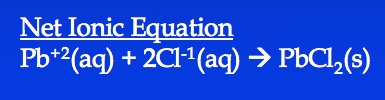
 Notice that sodium and nitrate are EXACTLY the same on the reactant and product sides?  They are spectator ions.  Spectator ions do not change in a reaction.  When you cancel the spectator ions, you're left with the net ionic reaction.

This shows us what is really changing in a reaction- the driving force for the reaction to proceed.

Aqueous Solutions


Water is a very polar molecule, meaning it has a partial positive charge on the hydrogen end and a partial negative charge on the oxygen end.  This is caused by the unequal sharing of electrons by the hydrogen and oxygen atoms.

Because water is polar, it will dissolve most ionic compounds.  Since ionic compounds are composed of a positive ion (cation) and a negative ion (anion), the opposite charged end of a water molecule will be attracted and break a large crystal into smaller pieces.  This is called hydration. If the molecules are completely broken into their ions by water, it is called dissociation.

For instance, table salt (NaCl) will completely dissociate in water. Every single molecule will be broken apart into ions and kept apart by the water molecules.
NaCl (aq) --> Na+ (aq) + Cl- (aq)

In chemistry, STRONG means that every molecule will dissociate when dissolved in water.  WEAK means that it partially dissociates, or that only some of the particles will dissociate while others will remain in neutral/molecular form.

Strong acids, strong bases and strong electrolytes will always dissociate when dissolved in water.  Weak acids, weak bases and weak electrolytes may or may not dissociate.

Tuesday, October 30, 2012

Solubility Rules


Soluble means a substance will dissolve in water, whereas insoluble means it will not dissolve appreciably. If an insoluble product is created in an aqueous solution, it will precipitate out of solution as a solid.


Solubility Rules
Mainly soluble:
all nitrates & acetates
all halogens, except with silver, mercury and lead
all chlorates, except with silver, mercury and lead
all sulfates, except with calcium, strontium, barium, lead, mercury, and silver
all chromates, except with calcium, strontium, barium, lead, mercury, and silver


Mainly insoluble:
all sulfides, except with groups 1 & 2, and ammonium
all hydroxides, except with groups 1 & 2, and ammonium
all carbonates, except with group 1 and ammonium
all phosphates, except with group 1 and ammonium

Steps in Balancing Reactions by Inspection


Law of Conservation of Mass- Matter can neither be created nor destroyed, only rearranged in
a chemical reaction.
 Steps in balancing a chemical reaction:
1. predict the products in words
2. write the formula for all the reactants and products
(balance the charges and look for diatomic elements)
diatomic elements - H, O, N, F, Cl, Br, I2
3. balance the polyatomic ions (nitrate. sulfate, hydroxide ...)
4. balance all other elements except hydrogen and oxygen
5. balance the hydrogen and oxygen  (don't forget to look for H and O in all compounds)
6. check every reaction again element by element 

Reactions: Basic Types


Synthesis (also called Addition, Composition and Combination)
     Atoms and or molecules are combined to make ONE more complex molecule.
A  +  B --> AB
Fe  +  S -->  FeS
metal oxide + water --> metal hydroxide
nonmetal oxide + water --> oxyacid

Decomposition (also called Analysis)
     A complex molecule is broken into simpler molecules and or atoms
AB --> A + B
KClO3 --> KCl  +  O2
metal chlorate --> metal chloride + oxygen
metal carbonate --> metal oxide + carbon dioxide

Single Replacement
     A single element replaces one component of a compound.  A metal must always replace a metal and a nonmetal must replace a nonmetal.  A single replacement replacement is a type of redox reaction where electrons are transfered from one atom to another.
A  + BX --> AX + B
K + CsCl --> KCl + Cs

X + AY --> AX  + Y
Cl2  +  MgBr2 --> MgCl2  +  Br2


Double Replacement (also called Ionic and Precipitation Reactions)
     Ionic compounds switch "partners."  Remember that a neutral compound must have a cation combined with an anion.
AX  +  BY --> AY  +  BX
CuCl  +  NaS --> CuS  +  NaCl

Monday, October 22, 2012

Determining an Empirical Formula


One way of determining the identity of an unknown in a lab is by analyzing its mass to determine its empirical formula (lowest whole number ratio of each element in a compound).  There are several types of problems, but all of them use the same concepts to start.

Example 1:  An unknown substance is composed of 24.7% potassium, 34.7% manganese and 40.5% oxygen.  Determine the empirical formula for this compound.
Problem!  You can't compare percentage by mass to determine the ratio of ATOMS!

  1. The first step is to convert the percentages to MOLES using the MOLAR MASS for each element.
  2. Once you have all the substances in moles, you can compare them to find the mole ratio.  There are several ways of doing this.  The easiest is to divide by the smallest value.  This usually works, but remember that an empirical formula is written in the LOWEST WHOLE NUMBER ratio, so if you a left with a fraction, you must multiply the entire ratio by a factor that will convert the fractions into WHOLE NUMBERS.
  3. Therefore the ratio of K:Mn:O is 1:1:4, so the empirical formula is KMnO4.