Tuesday, January 22, 2013

Determining Oxidation Numbers


Oxidation numbers are the "effective charge" a particle has in a molecule or ion.  While all atoms WANT to have a full outer shell, and they TRY to lose or gain electrons, they sometimes aren't able to.  We all know that you don't always get what you want.  Sometimes 2 non-metals are forces to share electrons.  Both WANT to gain electrons, but the more electronegative element will get the electrons most of the time.  In other words, they don't share equally.  Oxidation numbers tell us what the charge really is in a particle situation.  Manganese can form a +2, +4, +5 and even +7 charge depending on what other atoms are around to take its electrons.  While sulfur wants to gain 2 electrons and form a -2 charge, it is very common for oxygen to grab its electrons and sulfur is left with a +6 charge.  It now has a full outer shell because its lost ALL its valence electrons.

Follow these rules to determine the oxidation number of an ion-


You can calculate the charge of an ion by using the entire compound (must =0) or a polyatomic ion (must = the charge given).  Here are 2 ways to calculate the charge of sulfur in sulfuric acid.


No matter which method you use, the oxidation number of sulfur in sulfuric acid is +6.

Friday, December 14, 2012

Mid-Term Review

Please ask questions here, not email, so everyone can benefit.

Tuesday, December 4, 2012

Molarity


Molarity is a method of representing concentration.  In this case, it is the ratio of the moles of solute to the liter of solution. The abbreviation for molarity is a capital M (MUST be capitalized, "m" means molality).
Reminder- Solute is the substance that is dissolved or dispersed in a solution. Solvent is the substance that actively separates or disperses the solute. Water is the most common solvent.

There are 3 possible unknowns for simple problems dealing with molarity- M, g of solute, L of solution.

Example 1- What is the molarity of a solution made from completely dissolving 5.25 g of NaCl in 435 mL of water?


Example 2- How many grams of NaCl are needed to make 200.0 mL of 0.0150 M solution?

Example 3- How many mL of water are needed to make a 0.250 M solution using 10.00 g of NaCl?

Stoichiometry: Limiting Reactants


To put it in simplest terms, the limiting reactant is whatever runs out first. Once one of the essential components runs out, you can't make anymore of the final product.

Basic Example 1- A company builds little red wagons.  Each wagon must have a body, 4 wheels and 2 axels. If the company has 125 bodies, 400 wheels and 300 axels in stock, how many complete wagons can they produce?

While there are several ways of approaching this, we'll solve for the maximum number of complete wagons that can be made from the number of each component given.

While there are sufficient bodies and axels to make more wagons, once the company makes 100 wagons, it will run out of wheels. The wheels are the limiting reactant and therefore all other amounts are dependent on them.

Basic Example 1 con't- How many axels will the company have left over after all the wheels are used?

300 axels were available - 200 axels used = 100 axels left over

Now let's look at chemistry example-

Example 2 - 204.3 g of sodium hydroxide reacts with 79.4 g of aluminum chloride. How many grams of the base will be produced?


After 43.8 g of  aluminum hydroxide is produced, all of the aluminum chloride will be consumed (used up), so the reaction stops. Therefore the aluminum chloride is the limiting reactant (also called the limiting reagent). There will be sodium hydroxide left over- it is in excess.

Example 2 con't - What will be the mass of the excess reactant remaining?

To determine the amount remaining, we must know how much we started with (204.3 g NaOH) and how much will be used. To find how much is needed, we start with the LR (in this case, the 74.9 g of aluminum chloride).

Therefore, 204.3 g initially - 67.3 g needed = 137 g NaOH remaining


Wednesday, November 28, 2012

Mass-Mass Stoichiometry


In a mass-mass calculation you are given information in grams and asked for information in grams.  To complete stoichiometry problems you must know the ratio of particles.  The only way to determine this is by writing a balanced reaction.  The coefficients will provide you with the MOLE RATIO.

Remember that a reaction tells you the ratio of particles or moles, NOT MASS!  A gram of one substance will not have the same number of particles as a gram of another substance. That means you will need to convert grams to moles using molar mass.

We approach this type of problem using the same problem solving steps that we've been using all semester.

  1. What are we given?
  2. What are we looking for?
  3. What additional information is needed?
Let's walk through an example problem:
     Example 1:  An excess amount of sodium chloride reacts with 25.0 grams of lead (II) nitrate in water.  How many grams of precipitate will be formed?
  1. What are we given?
    excess NaCl, 25.0 g Pb(NO3)2
  2. What are we looking for?
    grams of solid (?)
  3. What additional information is needed?
    reacts means a reaction, so you need a balanced reaction
    grams means at some point molar mass will be needed
    solid, means you need to know what precipitates, so you need states


Example 2: How many grams of NaCl are actually needed to react all 25.0 g of lead (II) nitrate?


Tuesday, November 6, 2012

Ionic Reactions


In a molecular or complete reaction, all substances are shown in neutral (molecular) form.

In an ionic reaction, the substances that all always dissociate (strong) are broken into their ions.


Because lead (II) nitrate, sodium chloride and sodium nitrate all all soluble salt (strong electrolytes), they will all completely dissociate in water.  They will not exist as molecules, but as ions.  Remember you can't lose any mass in a reaction!  The Law of Conservation of Matter still applies!


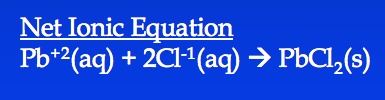
 Notice that sodium and nitrate are EXACTLY the same on the reactant and product sides?  They are spectator ions.  Spectator ions do not change in a reaction.  When you cancel the spectator ions, you're left with the net ionic reaction.

This shows us what is really changing in a reaction- the driving force for the reaction to proceed.

Aqueous Solutions


Water is a very polar molecule, meaning it has a partial positive charge on the hydrogen end and a partial negative charge on the oxygen end.  This is caused by the unequal sharing of electrons by the hydrogen and oxygen atoms.

Because water is polar, it will dissolve most ionic compounds.  Since ionic compounds are composed of a positive ion (cation) and a negative ion (anion), the opposite charged end of a water molecule will be attracted and break a large crystal into smaller pieces.  This is called hydration. If the molecules are completely broken into their ions by water, it is called dissociation.

For instance, table salt (NaCl) will completely dissociate in water. Every single molecule will be broken apart into ions and kept apart by the water molecules.
NaCl (aq) --> Na+ (aq) + Cl- (aq)

In chemistry, STRONG means that every molecule will dissociate when dissolved in water.  WEAK means that it partially dissociates, or that only some of the particles will dissociate while others will remain in neutral/molecular form.

Strong acids, strong bases and strong electrolytes will always dissociate when dissolved in water.  Weak acids, weak bases and weak electrolytes may or may not dissociate.