Thursday, February 3, 2011

Oxidation & Reduction

Redox reactions are reactions in which particles change charge by either losing or gaining electrons.  Whether a particle loses are gains is determined by its electronegativity, or attraction for shared electrons.  We've actually used this before in single replacement reactions.  A more active metal or nonmetal can replace a less active metal because it can either take or force another element to take electrons.

Reduction occurs when a particle gains electrons.  In other words by gaining negative charges, its charge is reduced.  Oxidation means a particle has lost electron, therefore its charge will become more positive.  There are several pneumonics you can use to remember this.


Thus far we have been balancing reaction only by mass.  We could do this because all the substance were written in neutral form.  Now we are using ions so we also have to balance a reaction by charge.


If the electrons are produced, they are being lost to the particle- they are no longer attached.  If the electrons are a reactant, they are being stuck on the particle- they've been gained.

Net Ionic Equations

Water is a very polar molecule, meaning it has a partial positive charge on the hydrogen end and a partial negative charge on the oxygen end.  This is caused by the unequal sharing of electrons by the hydrogen and oxygen atoms.

Because water is polar, it will dissolve most ionic compounds.  Since ionic compounds are composed of a positive ion (cation) and a negative ion (anion), the opposite charged end of a water molecule will be attracted and break a large crystal into smaller pieces.  This is called hydration. If the molecules are completely broken into their ions by water, it is called dissociation.

For instance, table salt (NaCl) will completely dissociate in water. Every single molecule will be broken apart into ions and kept apart by the water molecules.
NaCl (aq) --> Na+ (aq) + Cl- (aq)

In chemistry, STRONG means that every molecule will dissociate when dissolved in water.  WEAK means that is partially dissociates, or that only some of the particles will dissociate while others will remain in neutral/molecular form.

Strong acids, strong bases and strong electrolytes will always dissociate when dissolved in water.  Weak acids, weak bases and weak electrolytes may or may not dissociate.

In a molecular or complete reaction, all substances are shown in neutral (molecular) form.

In an ionic reaction, the substances that all always dissociate (strong) are broken into their ions.


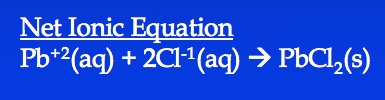
Because lead (II) nitrate, sodium chloride and sodium nitrate all all soluble salt (strong electrolytes), they will all completely dissociate in water.  They will not exist as molecules, but as ions.  Remember you can't lose any mass in a reaction!  The Law of Conservation of Matter still applies!


 Notice that sodium and nitrate are EXACTLY the same on the reactant and product sides?  They are spectator ions.  Spectator ions do not change in a reaction.  When you cancel the spectator ions, you're left with the net ionic reaction.

This shows us what is really changing in a reaction- the driving force for the reaction to proceed.

Oxidations Numbers

Oxidation numbers are the "effective charge" a particle has in a molecule or ion.  While all atoms WANT to have a full outer shell, and they TRY to lose or gain electrons.  We all know that you don't always get what you want.  Sometimes 2 non-metals are forces to share electrons.  Both WANT to gain electrons, but the more electronegative element will get the electrons most of the time.  In other words, they don't share equally.  Oxidation numbers tell us what the charge really is in a particle situation.  Manganese can form a +2, +4, +5 and even +7 charge depending on what other atoms are around to take its electrons.  While sulfur wants to gain 2 electrons and form a -2 charge, it is very common for oxygen to grab its electrons and sulfur is left with a +6 charge.  It now has a full outer shell because its lost ALL its valence electrons.

Follow these rules to determine the oxidation number of an ion-


You can calculate the charge of an ion by using the entire compound (must =0) or a polyatomic ion (must = the charge given).  Here are 2 ways to calculate the charge of sulfur in sulfuric acid.


No matter which method you use, the oxidation number of sulfur in sulfuric acid is +6.

Monday, November 1, 2010

Mass-Mass Stoichiometry

In a mass-mass calculation you are given information in grams and asked for information in grams.  To complete stoichiometry problems you must know the ratio of particles.  The only way to determine this is by writing a balanced reaction.  The coefficients will provide you with the MOLE RATIO.

Remember that a reaction tells you the ratio of particles or moles, NOT MASS!  A gram of one substance will not have the same number of particles as a gram of another substance. That means you will need to convert grams to moles using molar mass.

We approach this type of problem using the same problem solving steps that we've been using all semester.

  1. What are we given?
  2. What are we looking for?
  3. What additional information is needed?
Let's walk through an example problem:
     Example 1:  An excess amount of sodium chloride reacts with 25.0 grams of lead (II) nitrate in water.  How many grams of precipitate will be formed?
  1. What are we given?
    excess NaCl, 25.0 g Pb(NO3)2
  2. What are we looking for?
    grams of solid (?)
  3. What additional information is needed?
    reacts means a reaction, so you need a balanced reaction
    grams means at some point molar mass will be needed
    solid, means you need to know what precipitates, so you need states


Example 2: How many grams of NaCl are actually needed to react all 25.0 g of lead (II) nitrate?


Empirical Formulas from Percent Composition

One way of determining the identity of an unknown in a lab is by analyzing its mass to determine its empirical formula (lowest whole number ratio of each element in a compound).  There are several types of problems, but all of them use the same concepts to start.

Example 1:  An unknown substance is composed of 24.7% potassium, 34.7% manganese and 40.5% oxygen.  Determine the empirical formula for this compound.
Problem!  You can't compare percentage by mass to determine the ratio of ATOMS!

  1. The first step is to convert the percentages to MOLES using the MOLAR MASS for each element.
  2. Once you have all the substances in moles, you can compare them to find the mole ratio.  There are several ways of doing this.  The easiest is to divide by the smallest value.  This usually works, but remember that an empirical formula is written in the LOWEST WHOLE NUMBER ratio, so if you a left with a fraction, you must multiply the entire ratio by a factor that will convert the fractions into WHOLE NUMBERS.
  3. Therefore the ratio of K:Mn:O is 1:1:4, so the empirical formula is KMnO4.

Mole Conversions

While we tend to measure amounts in grams, the only way to compare amounts of atoms, molecules or ions is by using moles.  Unit analysis allows us convert one set of units to another.

To convert grams to moles, or visa-versa, we use molar mass that has the units grams/1 mole.

To convert number of particles to moles, or visa-versa, we use Avogadro's number (6.02 x 10^23) that has the units particles/1 mole.

Example: How many chlorine atoms are in 75.0 grams of sodium chloride?


Percent Composition

Percent always allows us to compare a part of something to the whole.
In general
% = part x 100
total
For percent composition
% = total mass of particles requested x 100
molar mass

Example: Determine the % oxygen in sulfuric acid.
% O =       4 oxygen          x 100
(2 H + 1 S + 4 O)

%O =               4(16.0) ___  _  x 100 = 48.9% O
                                                                     2(1.0) + 32.1 + 4(16.0)

Example: Determine the % sulfate in sulfuric acid.
%SO4 =               32.1 + 4 (16.0)___  _  x 100 = 97.9% O
                                                                    2(1.0) + 32.1 + 4(16.0)