Tuesday, January 22, 2013

Dalton's Law of Partial Pressure


Pressure is the force applied by the particles of a gas colliding with a surface such as the walls of a container.  If there is a mixture of gases, each individual type of gas particle will exert a pressure.  This is partial pressure, or the pressure exerted by a specific component of a gas mixture.

Dalton's Law of Partial Pressure states that the total pressure exerted by a mixture of gases will be the sum of the individual pressures of each of its components.

This concept can be combined with the ideal gas law to solve for the total pressure in a gas mixture.


Molar Volume and Avogadro's Principle


Avogadro's Principle states that equal volumes of gases at equal temperature and pressure, will contain the same number of particles.  Therefore now we can have a molar volume, just as we have a molar mass.

The molar volume of any gas at STP is 22.4 L.  This can be determined by using the ideal gas law.
REMEMBER! This only applies to a GAS at STP.

We can now apply this concept to chemical reactions.  If a reaction takes place at constant temperature and pressure, the ratio of all the gases (reactants and products) will be the same as the mole ratio.

Molar Volume and Avogadro's Principle


Avogadro's Principle states that equal volumes of gases at equal temperature and pressure, will contain the same number of particles.  Therefore now we can have a molar volume, just as we have a molar mass.

The molar volume of any gas at STP is 22.4 L.  This can be determined by using the ideal gas law.
REMEMBER! This only applies to a GAS at STP.

We can now apply this concept to chemical reactions.  If a reaction takes place at constant temperature and pressure, the ratio of all the gases (reactants and products) will be the same as the mole ratio.

Ideal Gas Law


In Ideal Gas Law calculations there is only one set of conditions (P,V,T), but we've added the idea of mass.


Combined Gas Laws


If the number of gas particles does not change, the pressure, volume and temperature will always combine to form a constant.  Because of this, the pressure times the volume and divided by the Kelvin temperature always be equal.  1 represents the initial conditions and 2 is the final conditions.
This is called the Combined Gas Law

By holding one of the three conditions constant, we can look at the relationship between any 2 of the variables.

Boyle's Law stated that if temperature is held constant, the pressure and volume for a sample of gas will be inversely proportional.  In other words, if the kinetic energy of a system is held constant, the force applied by its particles will be inversely proportional to the size of the container.  If the particles are moving at the same speed and the volume is decreased, the particles will hit the walls more often and apply more force.  If the volume is increased, the pressure will decrease.


Charles' Law states that if pressure is held constant, the volume and temperature will be directly proportional.  In other words, if the force applied by the particles on the walls of their container is constant, changes in the space occupied by the gas and their average kinetic energy must be directly proportional.  If you increase the temperature of a sample of gas, the particles will move faster.  To maintain a constant pressure (force on the walls), the container must get bigger.


Gay-Lussac's Law states that if the volume is held constant, the pressure and temperature must be directly proportional.  In other words, if the amount of space is constant (the container can't get bigger or smaller), if the particles move faster (temperature increases) they will have to collide with the walls of their container more, therefore more force.


Calculations:
  1. Label all given information. (P, T or V and 1 or 2)
    Remember it really doesn't matter what you label 1 or 2, but it IS IMPORTANT that you keep the SET of conditions together.
  2. Choose the correct formula and solve for the unknown algebraically.
  3. Substitute in the given information using both the value and UNIT.  Be careful to substitute the correct values 1 and 2 and to cancel the units.  You may need to use a conversion to make the units cancel.
  4. Don't forget that STP means Standard Temperature and Pressure.  These are a set of conditions!
  5. Don't forget that temperature must ALWAYS be in Kelvin.
    To convert Celsius to Kelvin, add 273.  To return to Celsius from Kelvin, subtract 273.

Standard Conditions: Pressure


For gas laws, standard pressure is considered the average pressure at sea level or 1 atmosphere (atm).

There are several other units used for pressure.

Using a barometer with mercury, standard atmospheric pressure will support a column of mercury 760 mm high.  This became a unit, or  mmHg.  Another name for mmHg is torr.
1 atm = 760 mmHg = 760 torrs

The SI unit is the pascal (Pa) which is equal to 1 Newton/meter2 . 
1 atm = 101.325 kiloPascals (kPa)

Standard Conditions: Temperature


For gases, standard temperature is considered the freezing point of water, 0˚C.  This causes a problem with mathematical calculations.  Temperature can be positive, negative or 0.  A positive ratio can't equal a negative number, and multiplying or dividing by 0 is 0 or undefined respectively.  To avoid this mathematical problem, the Celsius scale was shifted down to absolute zero. By using linear regression and Charles' Law, it is possible to determine the coldest possible temperature, or  -273.15˚C.

This new scale was called the Kelvin scale in honor of Lord Kelvin.  The gradations of the Kelvin scale are exactly the same as on the Celsius scale, the only difference is that 0 has been shifted to -273.  Therefore there are no negative values on the Kelvin scale.

Temperature is a measurement of the average kinetic energy of the particles of a substance.  If the lowest possible temperature is -273.15˚C, that means that the average kinetic energy must be 0, or that all molecular motion stops.


ALL CALCULATIONS IN GAS LAWS MUST ALWAYS BE CONVERTED TO KELVIN. To convert a Celsius temperature into Kelvin, just add 273.  To convert back from Kelvin to Celsius, just subtract 273.  *Note- by convention the degree symbol is not used for Kelvin.

Kinetic Molecular Theory: The Nature of Gases


When you look around, you don't see or notice the gases around you.  It appears that we are surrounded by empty space, but there are actually molecules of gases and particles in constant motion.

All gases:

  1. Gases have mass.
  2. Gases are compressible. The particles can be pushed closer together, decreasing the volume.
  3. Gases will expand their container. The particles can move farther part, increasing the volume.
  4. Gases diffuse. The particles expand to fill their container, therefore they mix and equally distribute themselves throughout the space.
  5. Gases exert pressure.  Gases apply a force by colliding with a surface.
  6. Pressure is related to temperature.  Temperature is average kinetic energy.  The higher the temperature, the more energy, therefore momentum each pas particle has.
The Kinetic Molecular Theory (KMT) states that gases are composed of tiny particles in constant motion. In reality, gases are effected by many variables.  Some have a large effect like temperature, while others have very effect, such as intermolecular forces.  In science, we simplify this concept by ignoring the smaller influences.  We call this an ideal gas.

Ideal gasses are assumed to:
  1. be composed of small hard particles.
  2. have an insignificant volume in comparison to the space they occupy.
  3. have only empty space between the particles.
  4. have no attractive or repulsive forces between the particles.
  5. are in constant, random, straight line motion.
  6. only change path when they collide with each other or the walls of their container.

Balancing by 1/2 Reactions


Oxidation and Reduction Reactions


Redox reactions are reactions in which particles change charge by either losing or gaining electrons.  Whether a particle loses are gains is determined by its electronegativity, or attraction for shared electrons.  We've actually used this before in single replacement reactions.  A more active metal or nonmetal can replace a less active metal because it can either take or force another element to take electrons.

Reduction occurs when a particle gains electrons.  In other words by gaining negative charges, its charge is reduced.  Oxidation means a particle has lost electron, therefore its charge will become more positive.  There are several pneumonics you can use to remember this.


Thus far we have been balancing reaction only by mass.  We could do this because all the substance were written in neutral form.  Now we are using ions so we also have to balance a reaction by charge.


If the electrons are produced, they are being lost to the particle- they are no longer attached.  If the electrons are a reactant, they are being stuck on the particle- they've been gained.

Dissociation and Hydration


Water is a very polar molecule, meaning it has a partial positive charge on the hydrogen end and a partial negative charge on the oxygen end.  This is caused by the unequal sharing of electrons by the hydrogen and oxygen atoms.

Because water is polar, it will dissolve most ionic compounds.  Since ionic compounds are composed of a positive ion (cation) and a negative ion (anion), the opposite charged end of a water molecule will be attracted and break a large crystal into smaller pieces.  This is called hydration. If the molecules are completely broken into their ions by water, it is called dissociation.

For instance, table salt (NaCl) will completely dissociate in water. Every single molecule will be broken apart into ions and kept apart by the water molecules.
NaCl (aq) --> Na+ (aq) + Cl- (aq)

In chemistry, STRONG means that every molecule will dissociate when dissolved in water.  WEAK means that it partially dissociates, or that only some of the particles will dissociate while others will remain in neutral/molecular form.

Strong acids, strong bases and strong electrolytes will always dissociate when dissolved in water.  Weak acids, weak bases and weak electrolytes may or may not dissociate.

Determining Oxidation Numbers


Oxidation numbers are the "effective charge" a particle has in a molecule or ion.  While all atoms WANT to have a full outer shell, and they TRY to lose or gain electrons, they sometimes aren't able to.  We all know that you don't always get what you want.  Sometimes 2 non-metals are forces to share electrons.  Both WANT to gain electrons, but the more electronegative element will get the electrons most of the time.  In other words, they don't share equally.  Oxidation numbers tell us what the charge really is in a particle situation.  Manganese can form a +2, +4, +5 and even +7 charge depending on what other atoms are around to take its electrons.  While sulfur wants to gain 2 electrons and form a -2 charge, it is very common for oxygen to grab its electrons and sulfur is left with a +6 charge.  It now has a full outer shell because its lost ALL its valence electrons.

Follow these rules to determine the oxidation number of an ion-


You can calculate the charge of an ion by using the entire compound (must =0) or a polyatomic ion (must = the charge given).  Here are 2 ways to calculate the charge of sulfur in sulfuric acid.


No matter which method you use, the oxidation number of sulfur in sulfuric acid is +6.

Friday, December 14, 2012

Mid-Term Review

Please ask questions here, not email, so everyone can benefit.

Tuesday, December 4, 2012

Molarity


Molarity is a method of representing concentration.  In this case, it is the ratio of the moles of solute to the liter of solution. The abbreviation for molarity is a capital M (MUST be capitalized, "m" means molality).
Reminder- Solute is the substance that is dissolved or dispersed in a solution. Solvent is the substance that actively separates or disperses the solute. Water is the most common solvent.

There are 3 possible unknowns for simple problems dealing with molarity- M, g of solute, L of solution.

Example 1- What is the molarity of a solution made from completely dissolving 5.25 g of NaCl in 435 mL of water?


Example 2- How many grams of NaCl are needed to make 200.0 mL of 0.0150 M solution?

Example 3- How many mL of water are needed to make a 0.250 M solution using 10.00 g of NaCl?

Stoichiometry: Limiting Reactants


To put it in simplest terms, the limiting reactant is whatever runs out first. Once one of the essential components runs out, you can't make anymore of the final product.

Basic Example 1- A company builds little red wagons.  Each wagon must have a body, 4 wheels and 2 axels. If the company has 125 bodies, 400 wheels and 300 axels in stock, how many complete wagons can they produce?

While there are several ways of approaching this, we'll solve for the maximum number of complete wagons that can be made from the number of each component given.

While there are sufficient bodies and axels to make more wagons, once the company makes 100 wagons, it will run out of wheels. The wheels are the limiting reactant and therefore all other amounts are dependent on them.

Basic Example 1 con't- How many axels will the company have left over after all the wheels are used?

300 axels were available - 200 axels used = 100 axels left over

Now let's look at chemistry example-

Example 2 - 204.3 g of sodium hydroxide reacts with 79.4 g of aluminum chloride. How many grams of the base will be produced?


After 43.8 g of  aluminum hydroxide is produced, all of the aluminum chloride will be consumed (used up), so the reaction stops. Therefore the aluminum chloride is the limiting reactant (also called the limiting reagent). There will be sodium hydroxide left over- it is in excess.

Example 2 con't - What will be the mass of the excess reactant remaining?

To determine the amount remaining, we must know how much we started with (204.3 g NaOH) and how much will be used. To find how much is needed, we start with the LR (in this case, the 74.9 g of aluminum chloride).

Therefore, 204.3 g initially - 67.3 g needed = 137 g NaOH remaining


Wednesday, November 28, 2012

Mass-Mass Stoichiometry


In a mass-mass calculation you are given information in grams and asked for information in grams.  To complete stoichiometry problems you must know the ratio of particles.  The only way to determine this is by writing a balanced reaction.  The coefficients will provide you with the MOLE RATIO.

Remember that a reaction tells you the ratio of particles or moles, NOT MASS!  A gram of one substance will not have the same number of particles as a gram of another substance. That means you will need to convert grams to moles using molar mass.

We approach this type of problem using the same problem solving steps that we've been using all semester.

  1. What are we given?
  2. What are we looking for?
  3. What additional information is needed?
Let's walk through an example problem:
     Example 1:  An excess amount of sodium chloride reacts with 25.0 grams of lead (II) nitrate in water.  How many grams of precipitate will be formed?
  1. What are we given?
    excess NaCl, 25.0 g Pb(NO3)2
  2. What are we looking for?
    grams of solid (?)
  3. What additional information is needed?
    reacts means a reaction, so you need a balanced reaction
    grams means at some point molar mass will be needed
    solid, means you need to know what precipitates, so you need states


Example 2: How many grams of NaCl are actually needed to react all 25.0 g of lead (II) nitrate?


Tuesday, November 6, 2012

Ionic Reactions


In a molecular or complete reaction, all substances are shown in neutral (molecular) form.

In an ionic reaction, the substances that all always dissociate (strong) are broken into their ions.


Because lead (II) nitrate, sodium chloride and sodium nitrate all all soluble salt (strong electrolytes), they will all completely dissociate in water.  They will not exist as molecules, but as ions.  Remember you can't lose any mass in a reaction!  The Law of Conservation of Matter still applies!


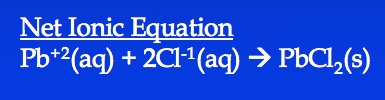
 Notice that sodium and nitrate are EXACTLY the same on the reactant and product sides?  They are spectator ions.  Spectator ions do not change in a reaction.  When you cancel the spectator ions, you're left with the net ionic reaction.

This shows us what is really changing in a reaction- the driving force for the reaction to proceed.

Aqueous Solutions


Water is a very polar molecule, meaning it has a partial positive charge on the hydrogen end and a partial negative charge on the oxygen end.  This is caused by the unequal sharing of electrons by the hydrogen and oxygen atoms.

Because water is polar, it will dissolve most ionic compounds.  Since ionic compounds are composed of a positive ion (cation) and a negative ion (anion), the opposite charged end of a water molecule will be attracted and break a large crystal into smaller pieces.  This is called hydration. If the molecules are completely broken into their ions by water, it is called dissociation.

For instance, table salt (NaCl) will completely dissociate in water. Every single molecule will be broken apart into ions and kept apart by the water molecules.
NaCl (aq) --> Na+ (aq) + Cl- (aq)

In chemistry, STRONG means that every molecule will dissociate when dissolved in water.  WEAK means that it partially dissociates, or that only some of the particles will dissociate while others will remain in neutral/molecular form.

Strong acids, strong bases and strong electrolytes will always dissociate when dissolved in water.  Weak acids, weak bases and weak electrolytes may or may not dissociate.

Tuesday, October 30, 2012

Solubility Rules


Soluble means a substance will dissolve in water, whereas insoluble means it will not dissolve appreciably. If an insoluble product is created in an aqueous solution, it will precipitate out of solution as a solid.


Solubility Rules
Mainly soluble:
all nitrates & acetates
all halogens, except with silver, mercury and lead
all chlorates, except with silver, mercury and lead
all sulfates, except with calcium, strontium, barium, lead, mercury, and silver
all chromates, except with calcium, strontium, barium, lead, mercury, and silver


Mainly insoluble:
all sulfides, except with groups 1 & 2, and ammonium
all hydroxides, except with groups 1 & 2, and ammonium
all carbonates, except with group 1 and ammonium
all phosphates, except with group 1 and ammonium

Steps in Balancing Reactions by Inspection


Law of Conservation of Mass- Matter can neither be created nor destroyed, only rearranged in
a chemical reaction.
 Steps in balancing a chemical reaction:
1. predict the products in words
2. write the formula for all the reactants and products
(balance the charges and look for diatomic elements)
diatomic elements - H, O, N, F, Cl, Br, I2
3. balance the polyatomic ions (nitrate. sulfate, hydroxide ...)
4. balance all other elements except hydrogen and oxygen
5. balance the hydrogen and oxygen  (don't forget to look for H and O in all compounds)
6. check every reaction again element by element